Asthma is the most common chronic disease of childhood.It is clinically manifested as repeated cough,shortness of breath ,chest tightness and wheeze.All the manifestations may not be present every time.Sometimes ,in children .there is no cough but only problem is shortness of breath and at other times ,there is no shortness of breath and the only problem is disturbing cough. Cough and shortness of breath/heavy breath/difficulty in breathing/dyspnea are more prominent during night,early morning,during running/playing,laughing and crying.Sometimes the child gets exhausted after the bouts of cough and occasionally, cough may be followed by vomiting. Family and or personal history of allergy may or may not be present.If present it supports the diagnosis.Blood eosinophil count-BEC may or may not be high,if high,it supports the diagnosis.Serum IgE level may or may not be high,if high it supports the diagnosis. Wheeze may be audible without stethoscope but it should be confirmed by physician.It is a musical sound heard continuously for few seconds mainly during expiration but may be heard during inspiration also. Sometimes squawk -Sqweaking -an inspiratory crackles followed by wheeze may be heard on chest auscultation,although it is typically heard in children with ILD
The cornerstone treatment of Asthma in children is inhalational steroid for a long time with inhalational short acting beta agonist-SABA/Salbutamol when symptoms increases or apperas in a child who remains asymptomatic for a long time either on medication or without medication. Incresae in symptoms suddenly is called asthma exacerbation/flare up which may be mild,moderate or severe .Treatment of exacerbation depends on severity of exacerbation.
GINA 2026 has given a simplest way to assess the severity of Asthma exacerbation in children between 2-17 years of age, which can be applied even at primary health care centres.This is called PRAM scoring.PRAM -Pediatric Respiratory Assessment Measure.
PRAM has 5 components with scoring
1.Spo2-score 0 if Spo2 is 95 % or more, Score 1 if between 94 % -92%, Score 2 if below 92%
2. Suprasternal retraction-Score 0 if no retraction and score 2 if retraction is present
3. Sacalene muscle retraction-Score is 0 if no retraction and score is 2 if retraction is present
4.Air Entry on chest auscultation-If air entry is good -score is 0, if it is diminished at bases of lungs score is 1,if diminished at apices as well as bases of lungs ,score is 2, if air entry is markedly diminished all over the lungs bilaterally or silent chest score is 3
5 .Wheeze-If on wheeze,score is 0, if wheeze is present but only during expiration ,score is 1, if it present both during expiration and inspiration ,score is 2, and score is 3 if silent chest or wheeze is audible without the use of Stethoscope
If the total score is 1-3 –Mild acute exacerbation of asthma
If total score is 4-7 –Moderate acute exacerbation of Asthma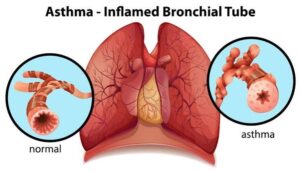
If total score is 8-12, acute severe exacerbation of asthma -PATIENT SHOULD BE CARED IN PICU
For more knowledge of Pediatric Pulmonology for better care of children- join Fellowship Program by clicking here-https://respifoundation.com
;