4 years ,male child came to the emergency department with high fever and difficulty in breathing for last 2-3 days
On examination,there was tachypnea,tachycardia with marked intercostal,subcostal and supra-sternal retraction
SPO2 breathing room air was 85 % and on chest auscultation ,there was deep inspiratory crackles ,more intense over the mammary region,right side lateral to the xiphoid bone,well correlating with the right middle lobe of lung
On starting oxygen via nasal prongs @ 2 litre per minute ,Spo2 improved to 94 % but chest retraction was persistent for over next 4 hours ,so the child was put on HFNC,with improvement in chest retraction over next 50-60 minutes.
On exploring the history ,the child suffered repeated chest infections with physician diagnosed Pneumonia 2 times in last one year.The child was diagnosed to have atopic dermatitis with recurrent symptoms and skin infections ,multiple times in last 3 years
On head to toe examination ,low set ear with sunken eyes was markable with depressed nasal bridge.
On investigation, TLC was 19800/cmm.with neutrophil predominance,high eosinophil percentage ,ESR was 40mm in first hour,platelet count 360000/cmm
Absolute neutrophil count was 9800, and absolute eosinophil count was 3220/cmm
On immunoglobulin profile testing the level of serum IgE was 2800 U/ml
Hemoglobin was 10.5 gm/dl
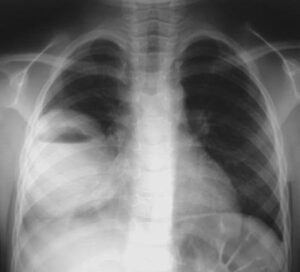
Chest X-Ray was done which revealed -lung abscess
Final diagnosis was recurrent Pneumonia with Lung abscess with Hyper IgE syndrome (JOB SYNDROME)
Case discussion
The child was having recurrent atopic dermatitis, recurrent Pneumonia and recurrent skin infections.
This triad is consistent with the diagnosis of Job Syndrome.
In addition to this triad,there occurs the facial deformity in the form of low set ear,depressed nasal bridge,coarse facial features, doughy skin,skeletal deformities in the form of scoliosis, osteopenia,osteoporosis with recurrent fractures of bones
Retained primary teeth is also a feature and facial features develops as the age advances.
Child may suffer from recurrent cold abscess over the skin.
These children have high chance to develop non Hodgkins Lymphoma later in life
Hyper IgE syndrome/Job syndrome is an autosomal dominant disease due to mutation in STAT 3 gene
In this syndrome, the count of neutrophil is normal but the function of nuetrophil is impaired with impaired chemotaxis and impaired production of cytokines .This leads to impaired inflammatory response resulting in cold abscess
Diagnosis
It is done by the evidence of recurrent respiratory infections,recurrent skin infections,atopic dermatitis with raised eosinophils,usually more than 3000/cmm and raised serum IgE level.
Diagnosis is confirmed by detection of mutation in STAT 3 gene
A variant of Job syndrome is DOCK 8 deficiency in which there is extensive eczema,food allergy and asthma.
In this variant ,in addition to bacterial skin infections,there occurs extensive viral skin infections like molluscum, HPV
This variant is autosomal recessive
Long term treatment /Prophylaxis
Apart from the treatment of current infections-long term co-trimoxazole is prescribed to prevent infections in Job Syndrome
In DOCK 8 deficiency -Definitive treatment is allogenic hematopoietic stem cell transplantation-HSCT
To learn Pediatric Pulmonology with Bronchoscopy and Sleep Study-Join Fellowship Program inPediatric Pulmonology with Bronchoscopy & Sleep Study under aegis of Respiratory Foundation of India.
Click here to apply for the course-https://respifoundation.com
WhatsApp-9899186848
Faculty-Dr.Deo Kumar Jha/Dr.D.K.Jha
Alumnus of AIIMS,New Delhi
Recipient of Dr.APJ Abdul Kalam Azad Health Award 2026 for Excellence in Pediatric Pulmonology,Bronchoscopy,Intensive Care & Sleep Study
REFERENCES:
-
Bazregari S, Azizi G, Tavakol M, Asgardoon MH, Kiaee F, Tavakolinia N, Valizadeh A, Abolhassani H, Aghamohammadi A. Evaluation of infectious and non-infectious complications in patients with primary immunodeficiency. Central-European journal of immunology. 2017:42(4):336-341. doi: 10.5114/ceji.2017.72825. Epub 2017 Dec 30 [PubMed PMID: 29479289]
-
Yong PF, Freeman AF, Engelhardt KR, Holland S, Puck JM, Grimbacher B. An update on the hyper-IgE syndromes. Arthritis research & therapy. 2012 Nov 30:14(6):228. doi: 10.1186/ar4069. Epub 2012 Nov 30 [PubMed PMID: 23210525]