3 weeks old New Born came to emergency with rapid rate of breathing and increased work of breathing for last 2 days.The baby was completely fine till 2 days back
The baby was born with normal vaginal delivery,cried immediately after birth,established breast feed within an hour of birth and staying with mother with no complaint after 1 week of follow up
On examination, the temperature was 98.6 degree F, Spo2 on room air 90 % and it was not improving on oxygen via nasal prongs @ 2 litre /minute, there was marked subcostal,intercostal and suprasternal retraction
On chest auscultation ,breath sound was diminished over right as well as left side of chest more over the supra-mammary regions
The baby deteriorated further and SPO2 dropped to 82 % and we had to intubate the baby and put on mechanical ventilation
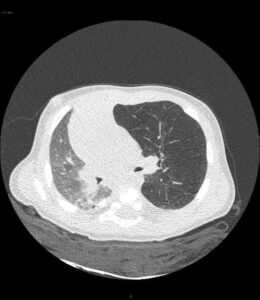
Chest X-Ray was done which revealed the diagnosis which was later confirmed on CECT Chest
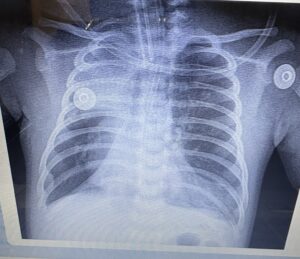
This chest Radiograph on the left side of 2 images is showing hyperinflated left upper lobe of lung with compression of other lobes of same side with herniation of left upper lobe to the opposite side compressing the right upper lobe.
There is shift of mediastinum toward the right-All findings favouring the diagnosis of Cogenital Lobar Emphysema–CLE
CECT Chest confirmed the diagnosis
Case Discussion:
In an infant presenting with respiratory distress without fever ,non infective cause should be suspected.
Causes may be related to respiratory system or cardiovascular system
The most common cause of respiratory distress in a new born infant is nasal blockage ,which should be looked for first as the infant up to the age of 6 months are predominantly nasal breathers
Congenital lung malformations are the important causes of respiratory distress in new born or infants during early infancy.
Sometimes these may present in late period after the infancy depending upon the size and site of malformations
In this new born ,markedly decreased breath sound over the left and right lung areas were confusing ,which may be due to collapse of lobes of lung or Pneumothorax
CLE is easily confused with Pneumothorax and treating physicians put chest tube erroneously to relieve the pleural pressure which is not there
Pathogenesis
CLE ,also called CLO-Congenital lobar overinflation is due to weakness of bronchial cartilages or bronchial stenosis.Sometimes it may result from vascular compressions.
Check valve machanism works in the affected bronchus which allows easy passes of air during inspiration but restricted passes of air during expiratotion causing hyperinflation of the affected lobe
Congenital lober overinflation is the correct term as there is no destruction of alveolar wall like emphysema
Most common lobes involved in decreasing order is left upper lobe,right middle lobe and right upper lobe
Diagnosis
Diagnosis is done by radio imaging and most of the time chest X-Ray reveals the diagnosis which shows hyperinflation of the affected lobe giving the impression of hyperluscent lung on affected side with compression of other lobes of the same side.There may be shifting of mediastinum to the opposite side. It is diffrentiated from pneumothorax by preservation of vessels in hyperluscent region and no margin of collapsed lung visible as seen in pneumothorax. Moreover, pneumothorax is a disease of pleural cavity whereas CLE affects the lung.
CECT Chest is helpful in differentiating it from other congenital lung malformations
Differential Diagnosis
It should be differentiated from Pneumothorax and CPAM
Treatment
It depends on the severity of case .In large CLE Causing respiratory distress,the treatment is surgical-lobectomy
In mild cases with no respiratory compromise ,continued observation with serial imaging may be the option
References
1. Demir OF, Hangul M, Kose M. Congenital lobar emphysema: diagnosis and treatment options. International Journal of Chronic Obstructive Pulmonary Disease. 2019;14:921–928
2. Kylat RI. Managing Congenital Lobar Overinflation Associated with Congenital Heart Disease. Children (Basel). 2020;7(9):113.
For more knowledge in Pediatric Pulmonology -Join Fellowship in Pediatric Pulmonology with Bronchoscopy & Sleep Study under Respiratory Foundation of India.
Faculty-Dr.Deo Kumar Jha/Dr.D.K.Jha, Alumnus of AIIMS,New Delhi,Recipient of Dr.APJ Abdul Kalam Azad Health Award 2026 for excellence in Pediatric Pulmonology,Bronchoscopy,Intensive Care & Sleep Study
Click here to apply for the course-https://respifoundation.com
WhatsApp-9899186848